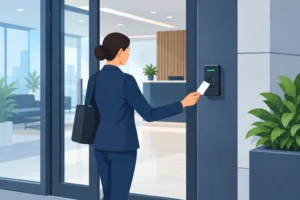
A front door, a loading bay and a staff entrance can all create very different risks. The right commercial premises access control guide is not simply about deciding who has a key or issuing proximity cards. It is about knowing who can enter each part of a site, at what time, for what purpose, and what happens when access needs to be challenged.
For facilities and operations managers, access control is a practical part of business continuity. Poorly managed access can expose staff, stock, data, plant and insurance compliance. Well-managed access supports safer working, clearer accountability and faster response when an alarm activates or an incident occurs.
What commercial access control should achieve
Commercial access control sets rules around entry to buildings, restricted areas and external grounds. These rules may be enforced through physical measures, electronic systems, procedures or, most effectively, a combination of all three.
The objective is proportionate control rather than making every movement difficult. An office with ten employees has different requirements from a multi-unit industrial estate, healthcare setting or vacant warehouse. The system should protect the areas that matter most without preventing legitimate staff, visitors, contractors and emergency services from doing their jobs.
A sound arrangement should establish four things: who is authorised to enter, where they may go, when their permission applies, and how access is recorded or reviewed. If these questions cannot be answered quickly, there is likely to be a gap in the security process.
Start with the premises, not the equipment
It is tempting to begin with cameras, keypads or card readers. The better starting point is a site-specific risk assessment. Walk the property as someone looking for an easy route in, then consider the operational reality of those using it.
Review public entrances, staff doors, fire exits, delivery points, gates, roof access, plant rooms, server rooms, stores and any shared corridors. Pay particular attention to entrances that are quiet outside normal hours. A side door that is adequately supervised at 9am may become the weakest point at 8pm.
Consider the consequences of unauthorised access at each location. In a retail setting, the priority may be stock loss and staff safety. In an industrial unit, it may be theft of tools, fuel or equipment, sabotage, or unauthorised vehicle access. For offices, confidential records and IT infrastructure may warrant tighter controls than the main reception area.
This assessment should also account for people. Shift workers, cleaners, delivery drivers, agency staff, visitors and contractors all need a defined route through the premises. Access arrangements that rely on informal knowledge, such as “someone normally lets them in”, are difficult to audit and easy to exploit.
Choosing the right level of control
There is no single access control method that suits every commercial property. The appropriate choice depends on risk, footfall, building layout, budget and the level of oversight required.
Mechanical keys remain useful, particularly for small sites and low-risk internal doors. However, they become harder to manage as staff numbers and locations increase. Lost keys may require locks to be changed, and keys can be copied unless tightly controlled. A documented key register, secure key storage and a clear issue-and-return process are essential.
Electronic fobs and cards offer greater flexibility. Permissions can be changed without replacing locks, access can be restricted by time, and some systems provide an audit trail. They are well suited to businesses with multiple teams, shift patterns or restricted zones. Their effectiveness still relies on regular administration: leavers must be removed promptly, lost fobs deactivated immediately and permissions reviewed.
PIN codes can be appropriate for lower-risk areas or temporary access, but shared codes are difficult to attribute to one person. They should be changed after staff departures, contractor work or any suspected compromise. For high-risk rooms, a code alone is rarely sufficient.
Biometric access can provide stronger assurance where identity is critical, although it comes with cost, privacy and data protection considerations. Businesses should have a clear reason for using biometric information and ensure the process is lawful, transparent and properly managed.
Physical measures remain equally important. A high-quality lock, well-maintained door closer, controlled gate, reception procedure or security officer can be more effective than an expensive electronic system fitted to a poorly secured door frame. Access control works as a layered measure, not as a single product.
Access control for commercial premises: define permissions clearly
Permissions should follow the principle of least privilege. In plain terms, people should have access only to the areas they need to perform their role. This reduces opportunity for theft, protects sensitive spaces and limits the impact if a credential is lost or misused.
Create sensible access groups rather than managing every individual from scratch. For example, office staff may need weekday access to the main building, warehouse staff may require early access to loading areas, and senior facilities personnel may need access to plant rooms. Visitors should be signed in, supervised where appropriate and issued temporary credentials that expire.
Contractors require particular care. Their access should be limited to the agreed work period and relevant area, especially where they are working out of hours. A contractor who has completed a one-day repair should not retain a live fob or know a door code months later.
Access permissions also need an owner. This may sit with facilities, HR, operations or a designated security lead, but responsibility must be clear. New starters, role changes, long-term absences and leavers should all trigger a documented access review.
Do not overlook opening, locking and key holding
Access control is most vulnerable at the beginning and end of the working day. The person opening a site may be entering alone, while the person locking up must confirm that staff, visitors, doors, alarms and vulnerable areas are properly accounted for.
A written open-up and lock-up procedure gives staff a repeatable process. It should cover external checks, alarm procedures, door and window inspections, visitor checks, key handling and escalation routes for anything unusual. It is not enough to say that the “last person out” locks the building.
Many organisations choose outsourced key holding and alarm response to remove this responsibility from employees. This can reduce the risk of staff attending a property alone after an alarm activation, particularly late at night. A trained, licensed security response team can attend, assess the situation, liaise with emergency services where required and secure the premises.
For sites across Greater Manchester with regular out-of-hours activity, mobile patrols can add visible reassurance and identify issues such as unsecured doors, damaged fencing or suspicious activity before they become a more serious incident.
Integrate access control with your wider security plan
Access records can be valuable after an incident, but only if the system is maintained and the information is reviewed when needed. Access control should sit alongside intruder alarms, CCTV, lighting, perimeter protection and response procedures.
For example, an alarm activation at a rear entrance may be easier to assess when there is a record of who last accessed that door, camera coverage of the area and an agreed response plan. Conversely, a card reader will not prevent tailgating if staff routinely hold doors open for unknown people. Procedures and staff awareness remain central.
Make sure emergency arrangements are considered at the design stage. Fire exits must remain compliant and usable in an emergency, while still being protected from misuse. Emergency services may also need rapid access. These requirements should be planned with competent security, fire safety and building professionals rather than treated as an afterthought.
Test, review and improve the arrangement
An access control policy is only reliable when it reflects what happens on site. Test it periodically. Try to establish whether former employees still have credentials, whether doors close properly, whether visitor records are complete and whether staff know what to do when they find a door unsecured.
Review the arrangement after a break-in, attempted intrusion, staff change, building alteration or change in operating hours. Vacant properties deserve a separate review because normal activity and natural surveillance disappear, making key holding, inspections and perimeter checks more significant.
KCS supports commercial clients with practical security services including key holding, alarm response, mobile patrols and open-up and lock-up support. The aim is to provide dependable control when a business needs experienced people on the ground, not just a procedure stored in a folder.
The most effective access control arrangement is one your team can follow every day, your managers can audit with confidence and your security provider can support when the unexpected happens. Begin with the real risks on your premises, assign clear ownership and keep the process under regular review. That is how access control becomes genuine protection for your people, property and operations.