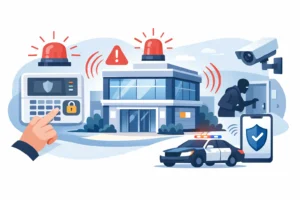
At 2am, when an alarm triggers and your site is empty, the real question is not who should be contacted. It is who should attend safely, lawfully and without delay. That is where key holding vs in house security becomes a practical business decision rather than a theoretical one.
For facilities managers, operations leads and business owners, the right answer depends on your site profile, staffing model, risk exposure and budget. Some premises need a permanent on-site presence. Others need dependable response, controlled access and out-of-hours cover without carrying the cost and complexity of a full internal team. The difference matters because poor arrangements do not just affect security – they affect staff welfare, compliance and business continuity.
Key holding vs in house security: what is the difference?
Key holding is an outsourced security service. A professional security provider retains authorised access to your premises and responds to alarm activations, emergency call-outs and access requests when needed. In many cases, key holding also sits alongside alarm response, mobile patrols, lock-up and open-up services, and checks on vacant or vulnerable property.
In-house security means employing your own security personnel directly. That may involve reception-based guarding, gatehouse cover, patrol officers, night staff or a dedicated internal security team. The business remains responsible for recruitment, vetting, licensing, supervision, training, absence cover and ongoing management.
Neither model is automatically better in every situation. The right choice depends on whether you need continuous on-site presence, reactive attendance, visible deterrence, or a broader mix of support across multiple sites.
When key holding makes more sense
Key holding is often the stronger option for businesses that do not need a guard on-site at all times but do need reliable response and secure access management. Offices, light industrial units, retail premises, medical sites, schools and vacant properties commonly fall into this category.
The clearest advantage is risk reduction for your own staff. Without a professional key holding arrangement, alarm activations often fall to managers, directors or nominated employees. That means asking people to attend dark, empty premises outside normal hours, sometimes with limited information about what caused the alarm. If the activation is genuine, they may be walking into confrontation. If it is false, they still lose time, sleep and working hours.
A trained external response team removes that burden. Attendance is handled by licensed professionals working to defined escalation procedures. That gives businesses reassurance that incidents are being managed by people used to securing property, assessing threats and dealing with police, fire services or authorised contacts where needed.
Cost is another major factor. Running an in-house team is rarely just about hourly wages. It includes pensions, holiday pay, sickness cover, recruitment costs, uniforms, supervision, training and compliance. If your actual requirement is for alarm response, opening and locking, or occasional attendance, employing internal staff can be disproportionate.
For multi-site businesses, key holding can be even more practical. A single outsourced arrangement can create consistent procedures across several locations, rather than relying on different managers or informal arrangements at each premises.
The operational benefits of key holding
A well-run key holding service brings structure to out-of-hours security. Access logs, response protocols, escalation routes and incident reporting are built into the service. That is especially valuable for businesses that need accountability, auditable processes and reduced dependency on individual staff members.
It also supports continuity. If a manager leaves, goes on holiday or is off sick, the service continues. The security process does not need to be rebuilt around personnel changes.
When in-house security is the better fit
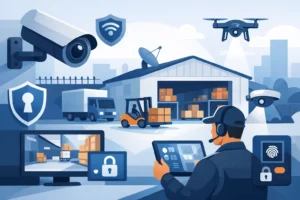
In-house security tends to suit businesses with a permanent on-site requirement. If you need someone visible at the entrance, carrying out regular internal patrols, monitoring visitors, handling deliveries or controlling access throughout the day and night, direct staffing may be justified.
This is often the case in higher-footfall environments, complex industrial operations, larger corporate sites or premises with sensitive assets and continuous activity. In these settings, a dedicated on-site team can become closely integrated with day-to-day operations. They know the building, the staff, the routines and the pressure points in a way that supports a broader operational role.
There can also be benefits where security duties overlap with customer service, concierge tasks or site-specific compliance procedures. An internal team may be easier to align with company culture and internal reporting lines, especially where security is one part of a wider facilities function.
That said, those advantages come with responsibility. The business must maintain standards, cover rotas, manage performance and ensure all licensing and training requirements are met. If the operation depends heavily on one or two key people, resilience can quickly become an issue.
Cost is not just about the headline figure
A direct comparison between key holding vs in house security can look simple on paper, but headline pricing rarely tells the full story. Outsourced key holding usually appears more cost-effective because you pay for a service model built around response and support rather than full-time staffing.
With in-house security, visible presence may deliver value well beyond incident response. But the true cost includes management time, recruitment delays, overtime, employer liabilities and the challenge of covering annual leave or short-notice absence. For businesses with limited internal resource, that administrative load can become a hidden cost in itself.
There is also the cost of getting it wrong. If untrained employees are acting as key holders and attending incidents, one poor decision can create far greater financial and legal exposure than any monthly service fee.
Response, safety and accountability
Response quality matters more than most businesses realise until something goes wrong. The question is not simply whether someone attends, but how they attend, what authority they have, and what process they follow once on-site.
Professional key holding arrangements are designed around controlled response. That means defined call-out procedures, secure access handling, incident verification and escalation. For many businesses, that level of discipline is exactly what is needed outside normal trading hours.
In-house teams can also deliver excellent response if properly resourced, but consistency depends on the calibre of staff and supervision in place. A well-managed internal operation can be highly effective. A lightly supervised one can become uneven very quickly, particularly across nights and weekends.
From a staff welfare perspective, outsourced key holding has a strong advantage. It prevents businesses from placing non-security employees in situations they are neither trained nor insured to handle confidently.
Compliance and standards should shape the decision
For commercial buyers, security is not just about presence. It is about trust, control and standards. Whoever holds keys, accesses the premises and responds to alarms must be operating with the right licensing, procedures and oversight.
That is why accreditations and operational discipline matter. An outsourced provider should be able to demonstrate recognised standards, secure handling procedures and experienced personnel. Internal teams require the same seriousness, but the responsibility for maintaining it sits entirely with the employer.
For some organisations, especially those with regulated environments or strict insurer expectations, outsourced support from an established specialist can reduce operational risk. Businesses in Greater Manchester and beyond often favour that route where they want dependable coverage without building a full internal security structure from the ground up.
A blended model is often the strongest answer
The choice is not always one or the other. Many businesses benefit most from a blended model. They may use on-site security during business-critical hours, then rely on key holding and alarm response overnight. Others retain internal facilities staff during the day but outsource lock-up, emergency response or vacant property inspections.
This approach gives flexibility. You keep internal visibility where it adds value, while outsourcing specialist response work that requires 24/7 readiness and controlled access procedures. It is often the most sensible model for growing businesses, multi-site operators and organisations reviewing costs without wanting to weaken protection.
A provider such as KCS is typically brought in at that point – not to replace every internal function, but to strengthen the areas where risk, response and out-of-hours reliability matter most.
How to decide what your business actually needs
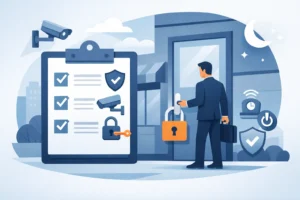
Start with the real security demand at your premises. If your main issue is alarm activations, opening and locking, lone worker risk, or empty-site access outside office hours, key holding is usually the more proportionate solution. If you need continual presence, visitor handling and active deterrence across occupied hours, in-house security may be the better fit.
Then look at failure points. Who currently attends alarms? What happens during sickness or holidays? How quickly can someone get to site? Are you relying on convenience rather than a proper security plan? Those questions usually reveal whether your current setup is resilient or simply familiar.
The best security arrangements are not built around habit. They are built around risk, response and accountability. If your premises, people and assets matter, the right model is the one that protects them reliably when the unexpected happens.
A good security decision should leave you with fewer vulnerabilities, fewer staff burdens and more confidence that, whatever time the call comes in, the right people will deal with it properly.