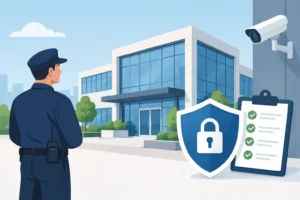
An alarm call at 2.13am is rarely convenient, and it is never risk-free. When a commercial alarm response service is in place, that call does not fall to a tired manager, an on-site employee, or a key holder travelling alone to a dark premises. It is handled by trained security professionals with clear procedures, controlled access, and the authority to respond properly.
For many businesses, that shift is more than a practical convenience. It reduces risk to staff, improves response discipline, and creates a more reliable way to deal with alarm activations, whether the cause is a genuine intrusion, attempted entry, damage, or a false alarm that still needs checking.
What a commercial alarm response service covers
At its core, a commercial alarm response service provides a professional attendance when an intruder alarm, panic alarm, or monitored alert is triggered at business premises. The response team attends site, assesses the situation, manages access, and takes the right next step based on what they find.
That sounds straightforward, but good alarm response depends on much more than simply turning up. A professional service should include secure key holding, agreed escalation procedures, incident reporting, and the ability to liaise with emergency services when required. It should also be backed by trained, licensed personnel who understand how to approach an alarm activation without exposing themselves or others to unnecessary danger.
For commercial sites, this matters because alarm events are not all the same. A small office with a single access point presents a different risk profile from an industrial unit, a healthcare setting, a retail premises, or a vacant property. The response needs to be proportionate, controlled, and documented.
Why businesses outsource alarm response
In many organisations, the first line of response still sits with directors, facilities teams, duty managers, or nominated key holders. That arrangement can work on paper, but it often creates weak points in practice.
A staff member may live too far away to attend promptly. They may be on annual leave, unavailable, or unsure how to handle a suspected break-in. More importantly, they may be placed in a situation that carries personal safety risks. Asking an employee to attend a potentially compromised site outside working hours is not always reasonable, and in some settings it is plainly unsuitable.
Outsourcing response removes that burden. It means the alarm activation is handled by a security provider operating to defined procedures, with staff trained for lone working, site attendance, access control, and incident management. That reduces dependence on internal availability and gives the business a more consistent response model.
There is also an operational benefit. When alarm activations are managed externally, internal teams are not constantly pulled into out-of-hours disruption. That can be especially valuable for businesses with multiple sites, high-value stock, sensitive records, or premises that must be ready to open as normal the next morning.
The difference between response and simply holding keys
Key holding and alarm response are closely linked, but they are not identical. Key holding means a trusted provider securely retains authorised keys or access credentials for your premises. Alarm response is the active service that follows when there is an activation or security incident.
Without secure key holding, alarm response can become slower or more complicated. A responder may need to wait for a manager to attend, which defeats much of the purpose. With both services combined, attendance is faster and entry can be managed in line with agreed instructions.
That combination is one of the main reasons commercial clients use specialist providers rather than relying on ad hoc arrangements. The provider is not just reacting to an alarm. They are stepping into a controlled process that has already been planned, authorised, and risk assessed.
What happens when an alarm is triggered
The exact sequence depends on the site and the monitoring setup, but the usual process begins with the alarm receiving centre or monitoring station notifying the response provider. The responder is then deployed with the relevant site details, access instructions, and escalation notes.
On arrival, the attending officer will usually carry out an external assessment before entry. They may look for signs of forced access, damage, suspicious activity, or obvious hazards. If the premises appear compromised, the approach changes. In some cases, police attendance may be required. In others, the site may need to be secured without full entry until the next step is agreed.
If entry is appropriate, the responder can inspect the premises, confirm whether the activation was false, identify any faults or security issues, and take immediate action where authorised. That could include locking up, arranging emergency boarding, isolating an access point, or contacting named stakeholders.
The final part of the process is often overlooked, but it matters. A professional response should result in a clear incident report. Businesses need to know what triggered the call-out, what was found, what action was taken, and whether follow-up works or security adjustments are needed.
Commercial alarm response service and staff safety
One of the strongest reasons to use a commercial alarm response service is duty of care. If a business expects employees or managers to respond to alarm activations at unsocial hours, it needs to consider the risk properly.
Even where an alarm turns out to be false, the person attending does not know that in advance. They may be approaching a site with no lighting, limited visibility, isolated access routes, or signs of attempted entry. If they attend alone and without training, the exposure is obvious.
Using a professional response service creates a safer and more defensible arrangement. It places attendance in the hands of people who are licensed, briefed, and equipped to assess the scene correctly. For many employers, that is not just a convenience decision. It is a responsible one.
Which businesses benefit most
Almost any commercial premises with a monitored alarm can benefit, but the value is often highest where the site carries out-of-hours risk or operational sensitivity. Offices with expensive equipment, warehouses holding stock, retail premises, schools, healthcare sites, industrial units, and vacant properties all have different vulnerabilities that can make alarm response essential.
Vacant properties are a good example. An empty building can quickly become a target for trespass, theft, vandalism, or unauthorised occupation. If an alarm activates, waiting until the next working day may allow a small incident to become a costly one. A prompt response can limit damage and help preserve the property.
Multi-site organisations also gain from a more centralised approach. Instead of relying on local site contacts to deal with each incident differently, they can work to one response standard across the estate.
What to look for in a provider
Not every provider offers the same level of assurance. For commercial buyers, accreditation, licensing, and operating standards should carry real weight. A provider trusted with keys, alarm attendance, and access to sensitive premises needs to demonstrate discipline, not just availability.
Look closely at whether officers are actively SIA licensed, how keys are managed, what reporting process is used, and how incidents are escalated. You should also ask about response coverage, support for lone key holders, and whether the provider can link alarm response with other services such as mobile patrols, lock-up, open-up, and vacant property inspections.
Experience matters too. A provider that understands commercial environments is more likely to make sound decisions when an incident is unclear or developing. Good response work is calm, procedural, and accountable. It should never feel improvised.
For businesses in Greater Manchester and beyond, local responsiveness can be a practical advantage, but only when it is matched by proper controls, trained personnel, and recognised standards. That is where established operators such as KCS stand apart – not simply by attending alarms, but by doing so within a dependable security framework.
The cost question businesses often ask
Some businesses hesitate because they view outsourced alarm response as an added expense. In reality, the comparison should be broader. The real question is what it costs to rely on internal staff, delayed attendance, inconsistent procedures, or an unsafe key holder arrangement.
There is no single answer because it depends on site type, frequency of activations, and the level of support required. A small office may need a relatively simple setup. A larger estate with multiple access points and frequent out-of-hours activity will need something more structured. What matters is that the service fits the risk.
A cheap arrangement that cannot respond reliably, safeguard keys properly, or document incidents clearly is not good value. For most commercial organisations, peace of mind comes from knowing that when the alarm sounds, somebody capable is already dealing with it.
The best security arrangements are often the ones that remove uncertainty. A commercial alarm response service does exactly that – it gives your business a controlled, professional answer to one of the moments when hesitation can cost the most.