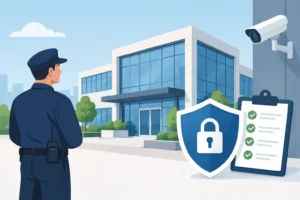
A 2am alarm activation is not the moment to find out whether your security provider has the right procedures, licences or response capability. Choosing accredited security providers is about far more than comparing prices. It is about placing keys, access codes, staff safety and the continuity of your business in capable hands.
For facilities managers, property managers and business owners, outsourced security should reduce pressure on internal teams while giving the business dependable protection around the clock. The provider you appoint must be able to demonstrate that its people, processes and service controls are ready for the responsibility.
Why accreditation should influence your decision
Security accreditation is not a marketing badge. It is evidence that a provider has been independently assessed against recognised standards and is required to maintain defined operating practices. This matters particularly where a supplier will hold keys, attend alarm activations, patrol isolated sites or access sensitive areas outside normal working hours.
The Security Industry Authority, or SIA, regulates the private security industry in the UK. An SIA Approved Contractor has been assessed against approved standards for areas including staff deployment, training, management systems and service delivery. It gives commercial clients a valuable starting point when assessing whether a provider operates with the discipline expected of a professional security business.
Individual licensing matters too. Security operatives carrying out licensable activity must hold an active SIA licence appropriate to their role. Ask how the provider verifies licences, manages renewals and ensures that the people attending your premises are authorised, trained and properly briefed.
Quality accreditation also has practical value. ISO 9001:2015, for example, demonstrates a structured quality management system. It should mean there are documented processes for handling client instructions, reporting incidents, reviewing performance and correcting problems when they arise. Accreditation cannot eliminate every risk, but it creates clearer accountability when a service is being delivered under pressure.
Choosing accredited security providers for your risk profile
The right provider depends on the site, the assets at risk and the consequences of a delayed or poorly managed response. A small office with standard alarm coverage has different requirements from a vacant industrial unit, a healthcare setting or a multi-site retail estate.
Start by identifying what you need the provider to protect. This may include the building itself, valuable stock, equipment, confidential information, visitors or employees working late. Consider when the greatest vulnerabilities occur. For some premises, it is overnight access. For others, it is the period between closing and opening, deliveries, lone working or an empty building becoming a target for trespass and damage.
A credible provider should ask detailed questions before recommending services. They should want to understand site layout, access points, alarm arrangements, key registers, existing security measures, escalation contacts and any known risks. A generic proposal with little reference to your operations may indicate that the service has not been properly planned.
There is also a balance to strike between coverage and cost. Manned guarding provides a visible presence and can be appropriate for higher-risk locations, busy public-facing environments or sites needing active access control. Key holding, alarm response and mobile patrols can provide strong protection at a more proportionate cost where continuous on-site guarding is not necessary. The best solution is the one that addresses genuine risk without paying for unnecessary resource.
Check the services behind the credentials
An accredited provider must still have the operational capability to deliver the service you require. Ask whether they provide key holding and alarm response, mobile patrols, open-up and lock-up support, vacant property inspections, manned guarding or key holder assistance. A broader service range can be useful as your risks change, particularly if you manage several locations or need additional cover at short notice.
Response arrangements deserve close attention. Find out how calls are received, who makes the decision to deploy, how response officers are briefed and what happens after arrival. A provider should be able to explain its escalation process clearly, including when police, emergency services, contractors or your nominated contacts would be involved.
Do not rely on a promised response time without context. Travel times vary by location, traffic, weather and simultaneous incidents. What matters is whether the provider has sufficient operational coverage, sensible deployment planning and transparent reporting. For businesses in Greater Manchester, local knowledge and a nearby operational presence can be especially valuable when rapid attendance is required.
Questions that reveal operational reliability
Before appointing a provider, ask to see how security instructions are created and maintained. Site instructions should be specific, current and accessible to the officers attending the property. They need to cover entry procedures, alarm panels, hazard information, key locations, contact details, approved actions and circumstances where entry should not be attempted.
You should also understand how keys and access information are controlled. Keys should be securely stored, traceable and released only under defined procedures. If codes, fobs or other access credentials are involved, clarify who can authorise changes and how records are protected. This is not administrative detail – weak key control can create a serious security exposure.
Reporting is another useful test. Following an alarm response, patrol or inspection, what will you receive and how quickly? A useful report records the time of attendance, observations made, action taken, photographs where appropriate and any follow-up required. It gives you an auditable record and helps identify recurring faults such as false alarms, damaged fencing or unsecured access points.
Ask how the provider handles continuity. If an officer is unavailable, a vehicle develops a fault or an incident requires additional support, there should be a clear contingency plan. Security is often judged by what happens when normal arrangements are disrupted. Providers that can explain their contingencies confidently are usually better prepared to protect your premises when circumstances change.
Look beyond a low monthly price
Security procurement can become overly focused on the headline rate. A low quote may look attractive until exclusions, call-out fees, limited reporting, inadequate patrol frequency or weak out-of-hours support become apparent. Compare proposals on the actual service model, not simply the monthly figure.
Be clear about contract terms, notice periods, included visits, charges for additional attendance and how service levels are reviewed. You should know who manages the account, how concerns are raised and what information will be provided at regular review meetings. A well-run security partnership should become more effective over time as the provider learns your sites and helps address emerging risks.
Experience is relevant, but it should be supported by current evidence. Long-standing providers often bring practical knowledge of alarm activations, vacant properties, key holding responsibilities and complex commercial environments. However, ask how that experience translates into current training, supervision and service controls rather than treating longevity alone as proof of quality.
Make accreditation part of a wider due diligence process
Accreditations should sit alongside practical checks. Verify the provider’s approved status and licences, request evidence of insurance, review relevant case studies or references, and assess how clearly the team communicates. The quality of the early conversations often reflects the quality of the working relationship to come.
It is also sensible to involve the people who understand daily site operations. A facilities manager may identify access problems that are invisible in a quotation, while an operations manager may know when the premises are most exposed. Their input helps ensure the security plan works in real conditions, not just on paper.
KCS combines SIA Approved Contractor Status, ISO 9001:2015 quality accreditation and active SIA licensing across staff and directors with practical, round-the-clock commercial security support. Those credentials matter because they are backed by established procedures for protecting property, responding to incidents and managing sensitive site access.
The provider you choose will be trusted at the moments your team may be unavailable or when an incident is already unfolding. Take the time to test credentials, procedures and response arrangements before signing an agreement. The right security partner should leave you with more than a contract – they should give you confidence that your premises are protected when it matters most.