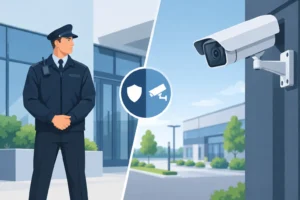
A camera can record an incident. A trained security officer can prevent it from escalating, challenge unauthorised access and take action when an alarm is raised. That practical difference sits at the centre of the static guarding versus CCTV decision for commercial premises.
For facilities managers and business owners, this is rarely a simple choice between people and technology. The right arrangement depends on the risk to the site, the value and nature of the assets being protected, operating hours, public access, insurance requirements and the level of response needed when something goes wrong. Often, the strongest security plan combines both.
Static guarding versus CCTV: the operational difference
CCTV gives a site eyes. Static guarding provides eyes, judgement and a physical presence. Cameras can monitor entrances, car parks, loading areas, corridors and perimeter points continuously, creating valuable evidence and allowing activity to be reviewed. With remote monitoring, an operator may also identify suspicious behaviour and escalate an incident.
A static security officer is positioned on site for an agreed shift or around the clock. Their duties may include controlling access, checking identification, monitoring visitors and contractors, conducting patrols, locking and unlocking buildings, responding to alarms, reporting hazards and providing reassurance to staff. They can make decisions in real time within agreed procedures.
That distinction matters when an issue requires immediate human intervention. An open fire exit, a delivery driver attempting to enter a restricted area or a person behaving aggressively cannot always be managed effectively through footage alone. Equally, a quiet, well-secured warehouse may not require a permanent officer if cameras, alarms and mobile response arrangements provide suitable coverage.
Where CCTV offers the greatest value
CCTV is a highly effective part of commercial security when the requirement is broad visibility across a large area. A well-designed system can cover locations that would be difficult for one officer to observe at the same time, including external boundaries, multiple entrances and isolated areas of a site.
It is particularly useful for recording incidents, investigating disputes, verifying deliveries and supporting health and safety reviews. Clear footage can help establish what happened, when it happened and who was involved. For multi-site businesses, centralised monitoring can also create consistency across locations.
CCTV may be a cost-effective choice where risk is relatively stable and predictable. For example, an office building that is empty overnight may benefit from cameras supported by intruder alarms, secure access control and a professional alarm response service. The system provides surveillance while a designated response team attends verified alarms or incidents that require a physical presence.
However, cameras have limits. They rely on correct positioning, lighting, maintenance, power and connectivity. Blind spots can develop when layouts change, vehicles obstruct views or vegetation grows around external cameras. Footage may only be useful after an offence has occurred, particularly where no live monitoring or response process is in place.
CCTV also does not carry out patrols, secure an unsecured door, escort a contractor or support staff during a difficult situation. It is a powerful security tool, but it is not a substitute for every human security function.
When static guarding is the stronger option
Static guarding is most valuable where deterrence, immediate intervention and visible control are priorities. A uniformed, SIA-licensed officer makes it clear that a site is actively protected. This can discourage opportunistic theft, trespass, vandalism and unauthorised access before an incident develops.
For premises with regular visitor traffic, a guard can bring order to the front of house. They can check credentials, manage sign-in processes, direct visitors, supervise contractor access and ensure that site rules are followed. In industrial settings, this may include monitoring vehicle movements, checking gates and supporting safe access at shift changes.
Static guarding is also suited to high-risk periods or sensitive environments. A retail site dealing with known antisocial behaviour, a vacant property exposed to repeated trespass, or a commercial facility holding high-value stock may need a capable person on site rather than surveillance alone. The officer can spot unusual behaviour, adapt to changing circumstances and contact emergency services or management when necessary.
The quality of the guarding service is critical. A static officer should work to clear assignment instructions, complete accurate records, understand escalation procedures and remain professional when dealing with staff, visitors and members of the public. The provider’s licensing, supervision, training and quality controls all affect the standard of protection delivered.
Cost is only one part of the decision
CCTV often has a lower ongoing cost than full-time static guarding once equipment has been installed, although monitoring, maintenance, upgrades and data management still need to be budgeted for. Static guarding is a continuing operational cost because it involves trained personnel, shift cover, supervision and management.
That does not automatically make CCTV the economical choice. The cost of a security measure should be considered against the potential consequences of a failure. A single incident involving stock loss, arson, business interruption, damage to reputation or risk to staff can exceed the apparent savings of a reduced security presence.
The more useful question is not simply, “What costs less?” It is, “What level of protection is proportionate to the risk?” A site with expensive equipment but limited public access may need remote monitoring and key holding. A busy premises with vulnerable staff or frequent public interaction may justify static guarding at key times. Security should reflect the genuine exposure of the business rather than follow a one-size-fits-all approach.
Response time changes the equation
The value of CCTV increases when it is paired with a reliable response plan. If footage or an alarm indicates a possible intrusion, someone must assess the situation and decide what happens next. Leaving a keyholder or employee to attend alone can expose them to unnecessary risk, particularly outside normal working hours.
Professional key holding and alarm response provides a safer route. A trained security team can attend alarms, inspect the premises, liaise with emergency services where required and keep the client informed. This arrangement means a camera system becomes part of an active security operation rather than a passive record of events.
Static guarding has the advantage of an immediate on-site response. There is no travel time, and an officer who knows the premises can investigate within agreed safety procedures. For sites where minutes matter, that presence may be decisive.
A combined approach often gives better coverage
The choice does not have to be static guarding or CCTV. Many commercial properties benefit from CCTV as a wide-area monitoring tool, with static guarding during trading hours, overnight activity, events, construction phases or other higher-risk periods.
A combined approach can also make guarding more effective. Cameras help officers monitor remote areas and review incidents, while officers can act on what they see. Access control, intruder alarms, mobile patrols, open-up and lock-up services, and vacant property inspections can then be added where they address a specific weakness.
For example, a Greater Manchester industrial unit may use CCTV and monitored alarms overnight, mobile patrols at variable times and a static officer during peak dispatch periods. An office building may require a front-of-house officer during the day, then rely on CCTV, secure locking procedures and alarm response after closing. Each plan is based on how the premises actually operate.
Questions to ask before choosing
Before deciding between static guarding, CCTV or a blended service, assess the site honestly. Consider whether the greatest concern is theft, unauthorised access, staff safety, vandalism, fire, vacant property risks or disruption to operations. Identify when the site is most exposed, who needs access and how quickly an incident must be handled.
It is also worth reviewing whether current measures are being used properly. Cameras that are not maintained, alarm codes shared too widely, poorly managed keys and inconsistent locking routines can undermine an otherwise sensible investment. Physical security works best when systems, procedures and people support each other.
KCS helps commercial clients build practical security arrangements around the risks they face, from manned guarding and mobile patrols to key holding, alarm response and property protection. The aim is clear: dependable protection without placing your own staff in avoidable situations.
A security review should leave you with a clear answer to one question: if an incident starts at your premises tonight, who will see it, who will respond and what will they be able to do? The right solution is the one that answers all three with confidence.