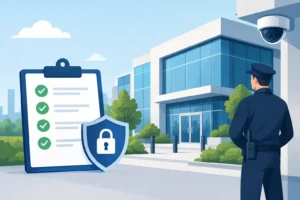
A business security checklist is most valuable when it reflects what actually happens at your premises after hours, during an alarm activation or when a member of staff is the last person to leave. It should identify who has access, how risks are spotted, and who can respond safely when something goes wrong. For facilities and operations managers, this is not paperwork for its own sake. It is a practical control that protects people, property and continuity of operations.
Start with your site-specific risks
No two commercial sites carry the same level of risk. A retail unit may be exposed to opportunist theft and out-of-hours intrusion, while an industrial estate may need stronger perimeter protection, vehicle gate control and regular patrols. A vacant office or unit presents different concerns again, including unauthorised access, damage, fire, water leaks and the appearance of neglect.
Walk the premises at the times when it is least occupied, rather than relying only on a daytime assessment. Check approach roads, car parks, delivery areas, fire exits, roof access points, plant rooms and shared corridors. Consider what an intruder can see, where they could gain cover, and whether a fault or incident would be noticed quickly.
Record the findings and rank them by likelihood and consequence. A poorly lit rear entrance may be a straightforward improvement. A site where a lone employee is expected to attend alarm activations is a more serious operational issue requiring an immediate change in procedure.
Business security checklist: access and key control
Keys, fobs, alarm codes and access permissions are among the most sensitive parts of a security plan. Yet they are often managed informally, particularly in growing businesses where staff responsibilities change quickly. If there is no clear record of who holds what, a lost key or departing employee can become a costly exposure.
Your arrangements should confirm that every physical key is logged, issued to a named person and returned when no longer required. Master keys need additional controls, with restricted access and a clear chain of custody. Keep spare keys in a secure, audited location rather than a desk drawer, filing cabinet or on-site hiding place.
Access control should also be reviewed. Remove former employees and contractors promptly, limit permissions to the areas people genuinely need, and investigate any access attempt that does not fit normal working patterns. For multi-site organisations, consistency matters: each location should follow the same approval, issue and return process.
Alarm codes deserve the same discipline. Change them when a key holder leaves, a code may have been disclosed, or a serious incident has occurred. Avoid sharing codes by text message or writing them where visitors or contractors can see them.
Test the perimeter and physical protection
A locked door is only one part of physical security. Effective protection depends on layers that make unauthorised entry more difficult, more visible and more likely to trigger a response.
Inspect doors, windows, shutters, fencing and gates for damage, wear or weak points. Pay close attention to hinges, locks, frames and areas hidden from public view. Lighting should cover entrances, footpaths, car parks and loading areas without creating glare that makes CCTV footage less useful.
CCTV and intruder alarms can provide valuable evidence and early warning, but only if they are maintained and monitored properly. Check that cameras have a clear view, recordings are retained for an appropriate period, and alarm systems are tested in line with the manufacturer’s and insurer’s requirements. A system that repeatedly produces false activations can lead to complacency, so faults should be investigated rather than accepted as routine.
Consider whether your physical measures match the value and nature of what is on site. A business storing high-value stock, specialist equipment or controlled materials may need more than standard locks and an alarm. Conversely, extensive measures at a low-risk office may not be proportionate. The right level of protection depends on the threat, the premises and the operational consequences of loss or disruption.
Make alarm response safe and dependable
An alarm activation at 2am creates a simple but critical question: who is attending, and are they equipped to do so safely? Asking a director, manager or employee to investigate alone can expose them to confrontation, uncertain hazards and unnecessary personal risk. It can also leave the business without a clear response if that person is unavailable, travelling or on holiday.
Set out an alarm response procedure that identifies the alarm receiving centre, nominated contacts, escalation order, emergency services information and site-specific instructions. It should state when staff must not attend, including where there is evidence of forced entry, a suspected intruder, fire, dangerous damage or a threat to personal safety.
Professional key holding and alarm response provides an alternative to placing employees in that position. A trained, licensed security officer can attend, assess the situation, liaise with emergency services where required and secure the premises. This gives businesses a controlled response at any hour while allowing key holders to remain out of harm’s way.
The procedure should be tested, not merely filed away. Run through a realistic scenario with relevant managers and make sure call-out details, key records and contact numbers remain current.
Protect staff, visitors and lone workers
Premises security is not solely about preventing theft. It is also about helping people arrive, work and leave safely. Review whether reception areas, visitor sign-in processes and contractor controls make it clear who is authorised to be on site.
Lone working requires particular care. Employees opening or locking up, working late, visiting remote areas of a warehouse or attending an empty property should have a defined check-in process and a route to urgent support. Avoid arrangements that depend on informal promises such as ‘call someone if you feel uneasy’. Set expectations, provide a reliable reporting method and act on missed check-ins.
Manned guarding, mobile patrols and scheduled open-up and lock-up services can be appropriate where staff safety, high visitor volumes or a visible security presence are priorities. The best approach depends on site hours, local risk, budget and whether the need is continuous or limited to specific periods.
Keep vacant properties under active supervision
Empty premises can deteriorate rapidly when no one is regularly checking them. A broken window, leaking pipe, unsecured gate or accumulating post signals that a site may be unattended. These issues can escalate into trespass, theft, arson, flooding or insurance complications.
Vacant property inspections should be planned at a frequency that reflects the condition, location and value of the site. Each visit should confirm that access points remain secure, utilities and alarms are operating as intended, signs of intrusion are reported and any developing issue is documented. Photographic records and clear reporting help property managers demonstrate that the site is being properly overseen.
Do not assume a vacant building needs less security than an occupied one. It may require more attention because there are no employees present to notice a problem early.
Check your provider and governance arrangements
Outsourcing security can reduce management burden, but the provider must be capable of handling sensitive access and response responsibilities. Ask how officers are vetted, trained and supervised, how incidents are reported, and how service performance is monitored. Relevant licensing and recognised quality standards provide useful reassurance, though they should sit alongside clear communication and a service plan that reflects your premises.
For businesses in Greater Manchester and beyond, local response knowledge can be valuable, especially where sites need regular patrols or rapid attendance. At the same time, multi-site operators may need a provider with the processes and coverage to maintain a consistent standard across locations.
KCS supports commercial clients with key holding, alarm response, patrols, guarding and property inspections, backed by SIA Approved Contractor Status and ISO 9001:2015 quality accreditation. These credentials matter because security arrangements only deliver peace of mind when the people trusted with access and response work operate to disciplined standards.
Review your checklist after any break-in, false alarm trend, change of staff, relocation, refurbishment or shift in operating hours. The most effective security plan is not the longest one. It is the one your team can follow confidently, and that gives your premises a dependable response when attention is needed most.