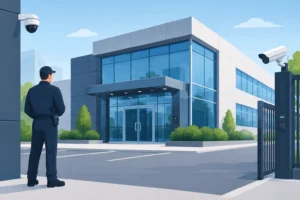
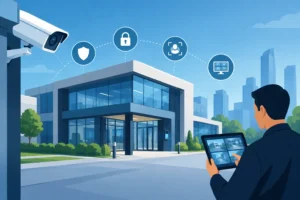
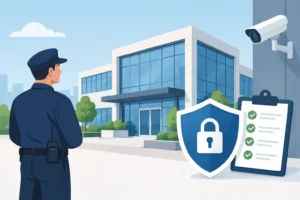
An alarm activation at 2am, an unfamiliar person attempting access, or an unsecured loading bay can quickly become more than a facilities issue. SIA licensed security guards give businesses confidence that the person responding has been properly trained, vetted and licensed to carry out regulated security work.
For facilities, operations and property managers, this is not simply a procurement detail. The quality, judgement and accountability of security personnel directly affect staff safety, business continuity, insurance risk and the protection of valuable premises and assets.
What SIA licensed security guards are responsible for
The Security Industry Authority (SIA) regulates the private security industry in the UK. A front-line SIA licence is required for many security roles, including security guarding and door supervision. It confirms that an individual has completed recognised training, passed identity and criminal record checks, and met the criteria required to work in a regulated role.
In a commercial setting, guards may be responsible for controlling access to offices, industrial units, retail premises and construction sites. They can conduct patrols, monitor visitors and contractors, report defects or suspicious activity, support safe opening and closing procedures, and take proportionate action when an incident occurs.
Their role is often preventative. A professional, visible presence can discourage trespass, theft, vandalism and unauthorised access before these issues develop into a costly incident. It also provides staff, visitors and lone workers with a clear point of contact when something does not feel right.
Licensing is a baseline, not the whole service
An SIA licence matters, but it should be viewed as the starting point rather than the complete measure of a security provider. A licence does not automatically mean that an officer understands your building layout, escalation procedures, operational hours or sector-specific risks.
Effective guarding depends on proper assignment instructions, site induction, clear communication and active management. The best arrangements match trained personnel to a defined security plan, with supervisors checking standards and ensuring that incidents are recorded, escalated and reviewed properly.
For example, a guard at a busy reception desk needs excellent visitor management and customer service skills. A mobile officer attending an alarm activation needs to make a calm, risk-led assessment, protect the scene and contact emergency services or nominated keyholders where necessary. Both roles require licensing, but the operational demands are different.
Why SIA licensed security guards reduce business risk
Commercial properties are rarely exposed to one type of risk. A vacant unit may attract trespass and damage; an occupied warehouse may face out-of-hours access risks; an office could need a reassuring security presence for employees working late. SIA licensed security guards provide a controlled response that can be adapted to these circumstances.
They help businesses reduce exposure in several practical ways:
- They establish a visible, accountable presence at vulnerable locations.
- They monitor access points, visitor movement and site conditions.
- They identify issues such as insecure doors, damaged fencing, fire safety concerns or signs of attempted entry.
- They follow agreed reporting and escalation procedures so managers have an accurate record of events.
- They can respond professionally to incidents without placing employees or keyholders in avoidable situations.
The value becomes particularly clear outside standard working hours. Asking a member of staff to attend an alarm call alone can create personal safety concerns and leave the business without a trained response. A security provider can attend, assess the situation and manage the immediate next steps in line with agreed instructions.
This approach also supports continuity. A prompt response to a broken window, forced door or water leak may limit the damage, protect stock and equipment, and help the site return to normal operation sooner.
Choosing the right licence and guarding service
Not every security requirement calls for a permanently stationed guard. A business with regular public footfall may need manned guarding at set times, while a low-occupancy site may be better served by mobile patrols, scheduled lock-up visits and alarm response. The right model depends on risk, operating hours, site size, access arrangements and the consequences of a delayed response.
When appointing a provider, confirm that officers hold an active licence appropriate to their duties. Security guarding and door supervision are distinct licence routes, although a door supervisor licence can permit some guarding activity. What matters is that the individual is legally qualified and practically suitable for the role they will perform.
It is also sensible to check how the provider verifies licences, manages renewals and covers absence. A service can only be dependable if there is a clear process for maintaining compliant staffing at all times.
Look beyond the individual officer
A guarding contract should give you more than a person at a gate or reception desk. Ask how the service is supervised, how often assignments are reviewed, and what happens if an incident exceeds the officer’s agreed authority or capability.
Strong providers will have documented procedures for incident reporting, lone working, key handling, emergency escalation and communication with clients. They should be able to explain how they recruit and vet staff, how officers are briefed for your site, and how performance concerns are dealt with.
Accreditations can provide useful reassurance too. SIA Approved Contractor Status demonstrates that a provider has met independently assessed standards in the services for which it is approved. Quality management accreditation, such as ISO 9001:2015, can also indicate a disciplined approach to service delivery and continuous improvement. These credentials should support, rather than replace, a detailed discussion about your premises and risks.
Security guarding and keyholding work better together
For many organisations, guarding forms part of a wider property protection plan. A static guard may oversee a busy site during operating hours, while keyholding and alarm response protect it after closure. Mobile patrols can provide a visible deterrent across larger estates or multiple locations, and open-up and lock-up services can reduce the need for employees to attend alone at unsociable hours.
This joined-up model gives decision-makers clearer accountability. Rather than relying on separate contractors with unclear responsibilities, a single security plan can define who attends an alarm, who secures a compromised site, who contacts authorised personnel and how evidence is documented.
At KCS, active SIA licensing is compulsory across staff and directors, reflecting the level of responsibility involved in protecting commercial premises. For businesses in Greater Manchester and beyond, that commitment is particularly relevant where keys, alarm codes, access control and urgent out-of-hours decisions are entrusted to a security partner.
Questions to ask before appointing a security provider
Before signing a contract, establish what protection your site genuinely needs. A provider should be able to discuss the likely threats to your premises, not simply offer a standard number of guarding hours.
Ask whether officers are licensed for the work required, how their licences are checked, and what site-specific training they receive. Clarify response times for alarm activations, the process for contacting your nominated representatives, and whether reports are provided after patrols or incidents.
It is also worth discussing practical details that are easily overlooked: who has access to keys, how keys are logged and transported, what authority an officer has to call emergency services, and how the provider manages holidays, sickness and unexpected staffing changes. Clear answers protect both parties and avoid confusion during an urgent event.
Price will always matter, but the lowest hourly rate is not necessarily the lowest-risk choice. Under-resourced security can lead to missed patrols, poor reporting, inconsistent cover and staff who are unfamiliar with the site. A properly managed service may cost more initially, yet it can prevent far greater disruption from theft, damage, unsafe access or a poorly handled incident.
A dependable security presence should make your working day quieter, not more complicated. When licensed officers, clear procedures and responsive support are in place, your team can focus on running the business while someone capable is protecting the premises when it matters most.