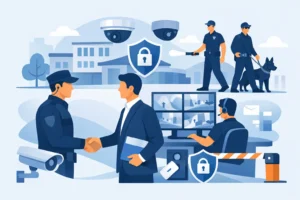
At 2am, an alarm activation rarely arrives at a convenient moment. For many businesses, the real problem is not only the alarm itself, but who is expected to attend, assess the risk and make the right decision under pressure. A key holder assist service is designed to remove that burden from employees and managers by providing trained security support when access to your premises is needed urgently or unexpectedly.
For commercial organisations, that matters for two reasons. First, alarm activations are not always straightforward. A false alarm, a sign of forced entry, an unsecured door or a fault with the system can all require a different response. Second, asking a member of staff to attend a dark, empty or potentially compromised site creates an avoidable risk. In many cases, the safest and most practical option is to have a professional security team attend alongside your nominated key holder, or in support of your key holding arrangement.
What is a key holder assist service?
A key holder assist service gives your business access to trained security personnel who attend your premises to support a key holder during an out-of-hours incident, alarm activation or urgent site access requirement. The service is there to reduce risk, improve response handling and help ensure the situation is managed professionally from the outset.
That support can take different forms depending on your operating model. Some businesses retain internal key holders but want security backup when they are called out. Others use outsourced key holding and need an experienced response team that can gain access, inspect the premises and coordinate next steps. The right arrangement depends on your staffing, your site risk profile and how quickly you need incidents contained.
In practice, key holder assistance is often used when there is uncertainty. If an alarm has been triggered and the cause is unknown, sending an untrained employee alone is rarely the best decision. A licensed security officer can attend, assess the surroundings, check for signs of intrusion and support safe entry procedures. That creates a more controlled response and gives decision-makers clearer information before any further action is taken.
Why businesses use key holder assist service support
The most immediate reason is staff welfare. Senior employees, facilities contacts and duty managers are often nominated as key holders because they know the premises and can authorise access. That does not mean they should face the risks associated with night-time attendance, suspected break-ins or lone entry.
A key holder assist service helps protect those individuals. Instead of arriving alone to an uncertain situation, your key holder has trained support on site. That may mean an external perimeter check before entry, a structured internal inspection once the premises are deemed safe, or simply having a professional presence there to manage access and reduce exposure.
There is also an operational benefit. Alarm activations can disrupt business continuity, especially when internal teams are left to work out what has happened with limited information. A disciplined response service brings procedure, reporting and accountability. If there is a genuine incident, it can be escalated appropriately. If it is a false alarm or systems fault, the issue can often be confirmed and closed down more efficiently.
For businesses with multiple sites, the value becomes even clearer. Managing key holder responsibilities across several locations can be inconsistent if different managers respond in different ways. A professional security provider brings a standard approach that helps reduce variation and keeps response handling aligned across the estate.
When a key holder assist service is most valuable
Some sites need this support more than others. Premises with high-value stock, exposed external access points, isolated locations or regular out-of-hours alarm activity typically benefit from a stronger response plan. Industrial units, offices, retail premises, healthcare settings and vacant properties often fall into this category.
It is also valuable where the business has limited on-call resource. Smaller organisations may not have the depth of staff to manage late-night attendance safely. Larger businesses can have the opposite issue – too many people with unclear responsibility, leading to delays or confusion when an incident occurs. In both cases, defined security support improves control.
There are trade-offs, of course. Some organisations prefer to keep key holder duties entirely in-house because they want direct control over access decisions. That can work well if they have trained personnel, a clear escalation process and confidence that staff are not being put at unnecessary risk. But where there is any doubt, bringing in professional assistance is often the more responsible option.
What to expect from a professional response
A dependable service should be built around more than simply turning up. The quality of the response matters. Security officers attending in support of a key holder should be properly licensed, briefed on procedures and able to handle situations calmly and methodically.
That usually starts before attendance. Accurate contact protocols, site instructions, alarm information and access arrangements all need to be in place. Once on site, the response should follow a structured process, beginning with external assessment and progressing to safe entry only where appropriate. If there are signs of criminal activity, the scene should be managed carefully and escalated in line with agreed procedures.
Communication is equally important. The people responsible for the site need to know what has happened, what has been checked and whether any further action is required. Good reporting turns a stressful event into a manageable one. It also provides an audit trail, which is valuable for compliance, insurance and internal review.
For that reason, businesses should look beyond headline promises and ask practical questions. Who attends? How are staff vetted and licensed? What happens if there is evidence of forced entry? How are incidents recorded? The answers will tell you whether the provider is equipped for real-world response work rather than basic callout cover.
Key holder assist service and wider security planning
The best results come when key holder assistance is part of a broader security strategy, not a standalone fix. Alarm response, mobile patrols, open-up and lock-up procedures, vacant property inspections and manned guarding can all complement the service depending on the risks your organisation faces.
For example, repeated false alarms may indicate a maintenance issue, but they can also create complacency. If staff begin assuming every activation is harmless, response quality suffers. A professional security partner helps maintain discipline while also identifying patterns that may need operational attention.
Similarly, if your premises regularly require early access, late closures or contractor visits outside normal hours, key holder support may overlap with access control and lock-up routines. In those cases, combining services can improve efficiency and reduce the number of people handling sensitive keys and access decisions.
For businesses in Greater Manchester and similar commercial areas, response reliability can be especially important where properties are spread across industrial parks, mixed-use estates or urban locations with variable risk profiles. Local knowledge has value, but so does a provider with the systems and standards to deliver consistent support every time.
Choosing a provider you can trust
Entrusting someone with site access and incident response is a serious decision. Accreditations, licensing and experience should carry real weight here because they reflect how the service is run, not just how it is marketed.
An SIA Approved Contractor, supported by recognised quality standards such as ISO 9001:2015, offers a stronger level of assurance than an informal arrangement or lightly managed contractor. That does not automatically mean every service will suit every site, but it does indicate a more disciplined operating model. For businesses handling sensitive assets, regulated environments or multi-site responsibilities, that level of assurance is often essential.
Longevity matters as well. Security response is a service where experience shows in the detail – the quality of escalation, the judgement used on attendance, the consistency of reporting and the ability to stay calm when information is incomplete. These are not small things when an alarm activates in the middle of the night and someone has to make the premises safe.
KCS has built its service around that kind of dependable support, helping commercial clients reduce risk without adding complexity to their in-house teams. That is often the real benefit of outsourcing this function. You gain trained coverage, clear procedures and peace of mind, while your own people are free from unnecessary exposure.
A key holder assist service is not only about responding to alarms. It is about protecting staff, controlling risk and making sure the right people attend your premises in the right way when it matters most. If your current arrangements rely too heavily on employees taking personal responsibility for uncertain situations, it may be time to put a more secure plan in place.