A security incident rarely begins with a dramatic break-in. It may start with an unlocked service door, an unauthorised vehicle at a loading bay, a visitor who has not signed in, or an alarm activation when the building is empty. Understanding how manned guarding improves site safety helps businesses close these everyday gaps before they become costly disruption, loss or risk to people.
For commercial premises, a trained security officer provides more than a visible presence. They bring judgement, routine and accountability to the site, helping managers maintain control of access, respond proportionately to concerns and keep operations moving safely.
How manned guarding improves site safety every day
Manned guarding gives a site an informed human presence. Unlike a fixed security measure, an officer can assess changing conditions, speak to people, identify behaviour that does not look right and act within agreed procedures. This is particularly valuable where premises have several entry points, mixed staff and contractor activity, valuable stock, sensitive information or periods of low occupancy.
A visible deterrent to unwanted activity
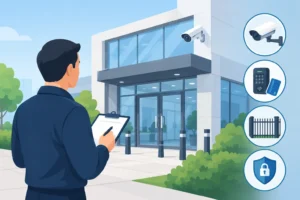
A uniformed officer at reception, on a gatehouse post or carrying out regular patrols makes a clear statement: the premises are actively protected. Opportunistic offenders are more likely to look for an easier target when they can see that access is supervised and that suspicious activity will be noticed.
The value is not limited to crime prevention. Visible guarding can discourage trespass, vandalism, fly-tipping and unauthorised parking, all of which can create safety, liability and operational issues. On vacant commercial property, an officer’s presence may also identify early signs of attempted entry or damage before the situation worsens.
Deterrence is strongest when it is consistent. A guard who understands the site, the normal pattern of activity and the people authorised to be there is far more effective than an occasional, unstructured visit.
Controlled access and better site discipline
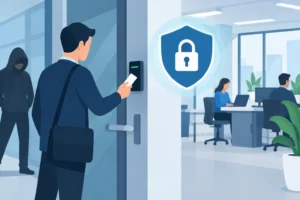
Many safety and security failures happen at the point of entry. Manned guarding helps ensure that staff, visitors, contractors and delivery drivers follow the correct process before moving around the premises.
An officer can check identification, manage visitor logs, issue passes, direct people to safe waiting areas and confirm that contractors have the appropriate authority before access is granted. At industrial sites, this may include keeping vehicle movements orderly at gates and ensuring drivers understand where they can report or unload. At offices, retail premises or healthcare environments, it may mean protecting restricted areas and maintaining a calm, professional reception point.
This approach also supports emergency preparedness. Accurate records of who is on site can assist with evacuations, welfare checks and incident investigations. The right level of access control depends on the site: a busy public-facing building needs a different approach from a warehouse with high-value goods. In both cases, a trained officer provides the human oversight that automated systems alone cannot offer.
Faster, informed responses when something changes
CCTV, intruder alarms and access-control systems are valuable tools, but they identify events rather than resolve them. A manned guard can investigate safely, verify what has happened and follow an agreed escalation plan.
That may involve checking an insecure door, challenging an unauthorised person, contacting a nominated key holder, calling emergency services or protecting an area until further support arrives. Because the officer is already familiar with the location, they can give clear, useful information rather than relying on someone to interpret an alert remotely.
A professional response is not about confrontation. Officers should be trained to observe, communicate, de-escalate where possible and operate within clear legal and site-specific instructions. This protects staff, visitors and the business while avoiding unnecessary risk.
Guarding protects people as well as property
For many businesses, the greatest benefit of manned guarding is reassurance for the people who use the premises. Lone workers opening or locking up, reception staff dealing with difficult visitors, and employees working late can all feel exposed when support is not immediately available.
A security officer can provide a controlled point of contact, assist with safe opening and lock-up procedures and respond to concerns before they become more serious. Their presence can be especially useful where staff may need to refuse access, enforce site rules or manage challenging behaviour but should not be expected to handle conflict alone.
This also reduces the pressure on managers and key holders. Rather than asking an employee to attend an alarm activation in the middle of the night or investigate a potential breach, businesses can put trained security personnel at the forefront of the response. That is a practical safeguard for employee welfare and business continuity.
Effective manned guarding depends on planning
Simply placing a guard on site is not enough. The quality of the service depends on clear instructions, appropriate training and regular management oversight. A reliable provider should begin by understanding the risks specific to the property, its operating hours, valuable assets, staffing patterns and known vulnerabilities.
From there, the assignment can be designed around the role the officer needs to perform. This could include front-of-house security, gatehouse duties, access control, patrols, vacant property checks, fire and safety observations, opening and closing responsibilities, or support during events and high-risk periods.
Clear assignment instructions matter. Officers need to know who is authorised to enter, which areas require additional protection, what to do if an alarm activates, how to report defects and when to escalate an incident. Good reporting creates an audit trail for the client and can reveal patterns such as repeated attempts to access a particular door or recurring safety issues in a loading area.
Technology still has a role. CCTV, electronic patrol monitoring and alarm systems can strengthen a manned guarding arrangement by providing evidence, accountability and additional coverage. The best results come from combining those systems with officers who can make sound decisions on the ground.
When is manned guarding the right choice?
Manned guarding is particularly effective when the consequences of an incident are high or the site requires regular human judgement. Examples include industrial estates, construction projects, distribution facilities, offices with controlled access, retail locations, healthcare settings and vacant properties.
It can be delivered as a continuous service, overnight cover, out-of-hours protection or support during defined periods such as deliveries, refurbishment works or seasonal trading. A permanent officer may not be necessary for every location. For a smaller, low-risk site, mobile patrols, key holding and alarm response may provide suitable protection at a lower cost. The decision should be based on the likely risks, the value of the assets, the impact of downtime and the safety of staff.
Where a premises has frequent public access, repeated security concerns or complex movement of people and vehicles, a dedicated officer often provides the stronger level of control. The key is to match the service to the actual risk rather than applying the same solution to every building.
Choosing a guarding provider with confidence
Entrusting a provider with access to your premises, staff and assets requires careful consideration. Businesses should look for a company that can demonstrate active SIA licensing, appropriate insurance, clear vetting processes, effective supervision and proven procedures for incident reporting and escalation.
Accreditations provide useful assurance. SIA Approved Contractor Status indicates that a provider has been independently assessed against recognised standards, while ISO 9001:2015 certification demonstrates a commitment to consistent quality management. Experience also matters, particularly where guards will be handling sensitive access arrangements, key holding responsibilities or out-of-hours incidents.
Ask how officers are briefed, how absences are covered, who supervises the assignment and how quickly concerns are communicated. A guarding service should feel like an extension of your own operation: professional with visitors, alert to risk and accountable to the people responsible for the premises.
For businesses in Greater Manchester and beyond, KCS delivers manned guarding as part of a wider physical security approach that can include mobile patrols, key holding, alarm response and open-up or lock-up services. This allows protection to be arranged around the way a property actually operates, rather than around a fixed package.
The right officer does more than stand at a door. They help create a safer, more orderly working environment where access is controlled, concerns are acted on and your people are not left to manage security risks alone.