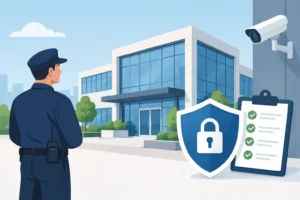
An alarm activation at 2.15am creates a difficult decision for any business. Someone with authorised access may need to attend, but asking an employee to enter an unlit commercial premises alone can expose them to avoidable risk. Keyholder assist explained simply is a professional security officer attending alongside your nominated keyholder, providing a controlled and reassuring presence while the situation is assessed.
For facilities and operations teams, the service sits between leaving a keyholder to manage an incident alone and outsourcing all alarm responses under a full key holding arrangement. It is particularly useful where a business wants to retain direct control of site access while giving staff appropriate support at vulnerable times.
What is keyholder assist?
Keyholder assist is an out-of-hours response service in which a licensed security officer meets an authorised representative at the premises following an alarm activation, access issue or other security concern. The officer supports the keyholder as they enter, inspect and secure the site in line with agreed procedures.
The precise scope should be set out in advance. It commonly includes meeting the keyholder at the site, checking the immediate external environment, accompanying them during an initial inspection and remaining present while alarm engineers, emergency services or other authorised contractors attend. If there are signs of forced entry, suspicious activity or a continuing threat, the officer follows the escalation plan rather than placing the keyholder in harm’s way.
This is not the same as a guaranteed diagnosis of why an alarm has activated. A security officer can identify visible concerns, record what they find and help control access, but alarm faults and system repairs remain the responsibility of the alarm provider or engineer. The value lies in safe attendance, disciplined decision-making and a clear response when normal working hours have ended.
Keyholder assist explained: how an attendance works
A well-managed attendance begins long before an alarm sounds. The security provider needs accurate site instructions, current keyholder contact details, access arrangements, hazard information and a clear escalation hierarchy. Without those details, even a prompt response can be delayed by uncertainty at the gate or door.
When an activation is received, the agreed keyholder is contacted and an officer is deployed or directed to meet them at the property. On arrival, the officer will usually assess the perimeter before entry. They may look for damaged doors, open windows, unusual vehicles, evidence of unauthorised access or any immediate safety concern.
If the property appears secure, the keyholder and officer can enter in accordance with the agreed procedure. The officer provides visible support while the keyholder checks the affected area, confirms whether the alarm can be reset and decides whether further attendance is required. They can also remain on site while an engineer investigates a fault, helping prevent the premises from being left exposed.
Where evidence suggests a break-in or immediate danger, the priority changes. The premises should not be entered simply to silence an alarm. Police attendance may be requested where appropriate, the keyholder can be kept at a safe distance, and the site can be protected until it is safe to proceed. A professional provider records actions, timings and observations so that the business has a reliable account of the incident.
Why businesses use assisted keyholder response
The most immediate benefit is personal safety. Directors, managers and office staff may hold keys because they are trusted, not because they have been trained to deal with a potentially compromised building in the early hours. A uniformed, SIA-licensed officer provides support at a point when uncertainty is highest.
There is also an operational benefit. Alarm activations can be disruptive, especially for organisations with multiple sites, lone-working staff or sites containing valuable stock, sensitive data or specialist equipment. Assisted attendance gives the nominated keyholder someone who can help apply procedure calmly, rather than requiring them to make every judgement alone.
For premises across Greater Manchester, response conditions can vary significantly between locations and times of night. Industrial estates, retail parks and isolated commercial units may be quiet after closing, while city-centre properties can present different access and public-safety considerations. Local knowledge and a properly planned response arrangement both matter.
The service can also protect staff wellbeing. Repeated false alarms, contractor call-outs and late-night attendances can place a heavy burden on a small group of managers. Keyholder assist does not remove that responsibility altogether, but it makes attendance more manageable and less isolating.
Keyholder assist versus key holding and alarm response
These services are related, but they meet different needs.
With keyholder assist, your own authorised representative attends the site and retains direct control of access. The security officer attends with them. This may suit organisations that have internal duty managers, require a senior employee to make operational decisions on site, or prefer to keep keys under their own control.
With a full key holding and alarm response service, the security provider securely holds designated keys or access credentials and attends alarm activations on the client’s behalf. The provider can inspect the premises, liaise with police or alarm engineers, reset the system where authorised and report the outcome. The client is only contacted when escalation is necessary.
Neither option is automatically better. Keyholder assist can be a sensible transition for businesses that want to improve employee safety without changing their access arrangements. Full key holding may be more appropriate where keyholders live far from site, alarms activate frequently, staff travel alone, or the business wants to reduce out-of-hours disruption as far as possible.
Where keyholder assistance adds most value
The service is often selected by businesses with a clear need for a decision-maker on site but an equally clear duty of care to that person. Examples include a warehouse manager attending after an intruder alarm, a property manager meeting an emergency contractor, or an operations lead opening a site following an access-control failure.
It can be especially useful for vacant or partially occupied buildings. Empty premises can attract trespass, vandalism and opportunistic theft, while alarms may be triggered by environmental faults or unsecured access points. An assisted attendance provides oversight while the authorised representative assesses next steps.
Healthcare, education, retail, offices and industrial sites can all benefit, but the plan must reflect the property. A large distribution facility needs different access instructions from a small office, and a multi-tenant building requires clear responsibilities for common areas, tenants and managing agents.
What to agree before appointing a provider
A keyholder assist arrangement is only as dependable as the instructions behind it. Review who is authorised to attend, who can approve additional works, and who should be contacted if the primary keyholder is unavailable. Contact details should be tested and updated whenever staff responsibilities change.
The provider should receive practical site information: alarm panel location, safe entry routes, gate codes, key safes, hazards, utility shut-off points, contractor contacts and any areas that must not be entered without specialist support. It is also sensible to agree what the officer may and may not do, particularly around alarm resets, police liaison and securing damaged access points.
Ask how incidents are recorded and reported. A useful report should confirm attendance times, the condition of the premises, actions taken, persons contacted and any follow-up required. This information helps facilities teams spot recurring alarm faults and demonstrates that incidents have been handled consistently.
Credentials matter as well. Security work involving keys, access and out-of-hours response demands a provider with properly licensed personnel, clear operating procedures and recognised quality standards. KCS brings SIA Approved Contractor Status, ISO 9001:2015 accreditation and experience built since 1998 to high-responsibility security duties.
A good keyholder assist service should make a difficult call-out feel controlled, not routine. When staff know they will not face an uncertain premises alone, they can make safer decisions and return the building to normal operation with greater confidence.