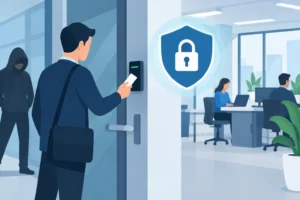
A door left unsecured after a delivery, a key handed to the wrong contractor or an alarm call answered too late can create a serious security incident. For commercial premises, knowing how to prevent unauthorised access is not simply about fitting better locks. It means controlling who can enter, when they can enter and what happens when normal controls fail.
The right approach protects people, stock, equipment, confidential information and business continuity. It also reduces the pressure on staff who may otherwise be expected to attend an alarm activation or challenge an unknown person outside working hours.
Start with a realistic access risk assessment
Every site has different pressure points. An office may be vulnerable through reception, shared entrances and confidential records. A warehouse may have multiple loading bays, perimeter gates and valuable stock. Vacant premises face a separate risk, as an empty building can quickly attract trespass, theft, vandalism or illegal occupation.
Walk the site as an unauthorised person might. Look beyond the main entrance and consider rear doors, fire exits, roof access, plant rooms, car parks, delivery areas and adjoining properties. Check whether fencing is intact, external lighting works, doors close properly and signage makes access rules clear.
It is equally important to identify when risk increases. Early mornings, late evenings, bank holidays, shift handovers and contractor visits often create gaps in supervision. A risk assessment should record these weak points and assign a clear control for each one, rather than relying on staff to notice a problem in the moment.
How to prevent unauthorised access with layered security
No single measure is enough on its own. Locks can be bypassed, access cards can be lost and CCTV may record an incident without preventing it. Effective physical security uses layers, so that a failure at one point does not give an intruder free access to the whole site.
Secure the perimeter first
The perimeter is where deterrence begins. Gates, fencing, walls and controlled vehicle access should make it clear where private property starts and where visitors must report. Damaged panels, unsecured side gates and overgrown landscaping can give someone both an easy route in and cover from view.
Good external lighting supports staff safety and makes approaches to the building more visible. CCTV can help monitor key areas, particularly entrances, yards and loading bays, but cameras need to be positioned for a useful view and checked regularly. Footage is of little value if the image is obscured, the system is not recording or nobody responds to an alert.
Control doors, keys and credentials
External doors should close and lock reliably, including those used for smoking areas, deliveries and emergency escape. Fire doors must always remain compliant with fire safety requirements, so security measures should be selected and installed with their intended emergency function in mind.
Electronic access control gives businesses a clear advantage over traditional keys where practical. Access can be limited by person, area and time of day, while lost cards or fobs can be cancelled without changing every lock. However, systems still need disciplined administration. Remove access immediately when an employee leaves, changes role or no longer requires entry to a restricted area.
Where physical keys are necessary, treat them as a controlled asset. Keep an accurate key register, record issue and return, limit master-key access and store spare keys in a secure key cabinet. Never leave keys in an unlocked drawer, under a desk or in a predictable hiding place. Key holding arrangements should also be reviewed when managers, tenants or contractors change.
Separate public, visitor and staff areas
A welcoming reception does not have to mean unrestricted movement. Visitors should know where to report, be verified before entry and, where appropriate, wear a visible pass. For higher-risk environments, escort visitors beyond reception and ensure their pass is returned when they leave.
Staff areas, server rooms, stock stores, medicines cupboards, plant areas and records rooms should have tighter controls than general offices. This limits the impact if someone gains entry through a public-facing area or follows an authorised employee through a door.
Tailgating is a common weakness. Staff may hold a secure door open out of courtesy without checking whether the person behind them has authority to enter. Clear training and a culture of polite challenge are more effective than blame. Employees should feel able to say, “Can I help you?” and direct unfamiliar people to reception.
Manage contractors and deliveries without creating gaps
Contractors and delivery drivers often need access at times when regular staff are busy or absent. A standing arrangement such as “the engineer knows where the key is” creates avoidable risk, especially when subcontractors are involved.
Confirm appointments in advance, verify identity on arrival and give access only to the areas required for the work. Record who is on site, who authorised them and when they leave. If work must take place out of hours, agree the access process beforehand and ensure an authorised contact or security provider can respond if something does not look right.
Deliveries need similar care. Keep loading bays and goods entrances controlled, rather than allowing open access into the building. Staff should be alert to social engineering, where an individual uses a convincing uniform, delivery reference or urgent story to gain entry. A professional visitor will understand reasonable security checks.
Make alarm response part of the plan
An intruder alarm is a vital warning system, not a complete security strategy. Its value depends on what happens after activation. If the nominated keyholder is unavailable, too far away or unwilling to attend alone at 2am, the business may face a delayed response and an unnecessary risk to staff.
A professional key holding and alarm response service ensures alarm activations are assessed by trained, licensed personnel. The responder can attend the premises, liaise with emergency services where needed, secure the site and provide a detailed report. This avoids placing employees or directors in a potentially confrontational situation.
For businesses in Greater Manchester, a local mobile response arrangement can be particularly valuable where rapid attendance is required. KCS provides key holding, alarm response and mobile patrol services designed to maintain site security outside normal operating hours.
Keep vacant and low-occupancy properties protected
Empty units can appear easy to secure because there are fewer people coming and going. In reality, the absence of routine activity means issues can go unnoticed. A broken window, failed alarm, water leak or attempted entry may remain undiscovered long enough to cause substantial loss.
Inspect vacant properties at an agreed frequency and after severe weather, alarm activations or reported incidents. Checks should cover perimeter security, signs of entry, utilities, fire risks, damage and general condition. Regular visible patrols can also deter opportunistic intruders who believe a site is unmonitored.
Do not advertise vacancy unnecessarily. Remove post that accumulates, manage waste, maintain basic external presentation and ensure contact details for emergencies are current. If access is required by insurers, surveyors or prospective tenants, use a recorded handover process rather than leaving keys available on site.
Review the controls people rely on
Access security weakens gradually when procedures are not revisited. A door closer fails, an old fob remains active, a temporary contractor becomes a familiar face, or a key is copied without anyone recording it. Regular checks turn these small oversights into manageable maintenance tasks rather than incidents.
Review access permissions at least quarterly and whenever there is a staffing, tenancy or operational change. Test alarms, inspect physical barriers, reconcile keys and confirm escalation contacts. Managers should also examine incidents and near misses, including propped-open doors or unknown visitors, to understand where practice differs from policy.
The aim is not to make a workplace difficult to use. It is to make authorised access straightforward and accountable, while making unauthorised access difficult, visible and quickly addressed. When security responsibilities are clear and response arrangements are dependable, your premises remain protected even when your team is not there.