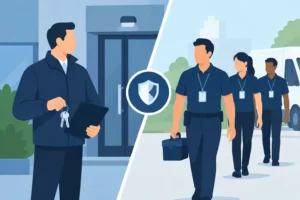
An alarm activation at 2.15am creates a decision that cannot wait until morning: who is going to attend the premises? For many businesses, the choice comes down to keyholding versus staff callouts. Asking an employee to respond may appear familiar and inexpensive, but it can transfer significant personal, operational and security risk to the business.
Professional keyholding gives organisations a controlled alternative. A trained, licensed security officer holds authorised access, attends when required and follows agreed procedures, allowing staff to remain safe while the incident is assessed. The right option depends on the site, the nature of the risk and the resilience expected from the response arrangement.
What staff callouts involve
A staff callout arrangement means designated employees, often managers, directors, facilities staff or business owners, are listed as keyholders with the alarm receiving centre. When an alarm is activated, they are contacted and expected to attend the site, usually outside normal working hours.
For a small, low-risk premises with limited opening hours, this can seem practical. The person attending knows the building, understands its operations and may be able to identify whether there is an obvious cause, such as a door left unsecured or a system fault.
The difficulty is that alarm activations are unpredictable. They may happen overnight, during a weekend, while the employee is on holiday, in poor weather or after a long working day. More importantly, the person responding usually does not know whether the activation is false, the result of attempted intrusion, or connected to a more serious incident.
A staff member arriving alone at a dark, potentially compromised site is placed in a position that few businesses would accept during normal operations. If there has been a break-in, the premises may still be occupied. There may also be damage, fire risk, flooding or a vulnerable person on site. The duty of care issue is clear: employees should not be expected to manage unknown security threats without suitable training, support and procedures.
Keyholding versus staff callouts: the practical difference
With a professional keyholding service, the alarm receiving centre contacts the security provider instead of relying on an employee to leave home and attend. A security officer responds in accordance with the agreed instructions, checks the external condition of the property, liaises with emergency services where necessary and takes appropriate action to secure the site.
This is not simply about having someone else carry a set of keys. Effective keyholding is a managed response service. It requires secure key control, verified access instructions, up-to-date emergency contacts and site-specific response protocols. The officer attending should understand the limits of their role and know when escalation is required.
For businesses, the key difference is consistency. Staff availability can change due to sickness, annual leave, role changes, distance from the site or personal circumstances. A contracted keyholding arrangement is designed to provide 24/7 cover, so a response does not depend on whether one named individual answers their phone.
It also separates everyday employment from high-responsibility incident response. Managers can concentrate on running the business, while trained security personnel handle alarm activations and site access issues within an agreed operational framework.
The risks businesses often underestimate
The most obvious risk of staff callouts is personal safety, but it is not the only concern. A delayed attendance can leave a property exposed following a forced entry or alarm fault. If no-one is available, police response may be affected by the nature of the activation and the information available to them.
There is also a risk of poor decision-making under pressure. An employee who is not trained in alarm response may enter the property too quickly, disturb a scene, overlook signs of entry or fail to secure an access point properly afterwards. Even a false alarm can become disruptive if the response process is unclear.
For multi-site organisations, these issues multiply. A single regional manager cannot reasonably provide dependable overnight cover for several locations, particularly if sites are spread across Greater Manchester or further afield. Rotas may look workable on paper but become difficult to maintain over time.
The less visible cost is staff fatigue. Repeated out-of-hours callouts can affect wellbeing, productivity and retention. It can also create tension when responsibility falls repeatedly on the same reliable people. Outsourcing the response removes that burden and gives the organisation clearer accountability.
When staff callouts may still be suitable
Professional keyholding is not automatically the right answer for every property. A very small office in a low-risk setting, with no valuable stock, no history of alarm activations and an owner living nearby, may decide that direct attendance remains proportionate.
Even then, the arrangement needs discipline. There should be more than one authorised keyholder, clear escalation instructions, secure key management and an understanding that staff should not enter a premises if there are signs of forced entry or any concern for safety. They should wait for police or security support where appropriate.
Businesses should review this decision whenever circumstances change. Increased stock values, new equipment, later operating hours, a move to an industrial unit or recurring alarm activations can all alter the risk profile. What was acceptable when the business started may no longer be a sensible approach.
When professional keyholding is the stronger option
Keyholding is particularly valuable where the consequences of an incident are high. This includes industrial premises, offices with sensitive information, retail sites, vacant properties, healthcare settings and locations holding valuable tools, equipment or stock.
It is also a strong fit where there is no suitable internal callout rota, where senior employees travel regularly, or where the business wants a clear boundary between employee duties and security response. For landlords and property managers, it can provide a dependable route to access and secure empty units without repeatedly involving tenants or site contacts.
A professional provider can also support more than alarm attendance. Depending on the agreed service, keyholding may sit alongside mobile patrols, open-up and lock-up duties, vacant property inspections and keyholder assist. This can reduce gaps between different parts of a property protection plan.
KCS provides key holding and alarm response through trained, actively SIA-licensed personnel, supported by established procedures for commercial premises. For decision-makers, provider credentials matter. Look for clear operational processes, secure handling of keys, documented reporting, appropriate insurance and recognised standards such as SIA Approved Contractor Status and ISO 9001:2015 quality accreditation.
Comparing the true cost
Staff callouts can look cheaper because there is no visible service contract. However, the comparison should include overtime or time off in lieu, management disruption, travel, rota administration, employee welfare and the cost of a poorly handled incident. One unsafe or delayed response can outweigh a long period of apparent savings.
Keyholding is a planned operating cost. This helps businesses budget for out-of-hours response while reducing reliance on informal arrangements. The precise cost will vary according to the number of sites, expected callout volume, key management requirements and the level of reporting needed.
The best question is not simply, “Which option costs less this month?” It is, “Which arrangement gives us reliable cover without exposing our people or premises to avoidable risk?” For many commercial organisations, that leads to a professional response service.
Set clear procedures before an activation happens
Whether a business uses staff callouts, keyholding or a combination of both, the response plan should be agreed before an alarm sounds. The alarm receiving centre needs accurate contact details and escalation instructions. Keyholder records must be kept current, particularly after staff changes.
Site instructions should cover access points, alarm panels, utility isolation, known hazards, emergency contacts and the steps to take if police, fire and rescue, or a locksmith is required. Keys and codes should be controlled carefully rather than passed informally between staff.
Regular reviews are equally valuable. If activations are frequent, investigate the cause rather than treating every callout as unavoidable. A reliable security arrangement protects the property, but it should also help identify patterns that can be corrected.
A well-managed keyholding service gives businesses more than someone to attend an alarm. It gives them a dependable plan for the moments when the building is empty, the risk is unclear and staff should be safely at home.