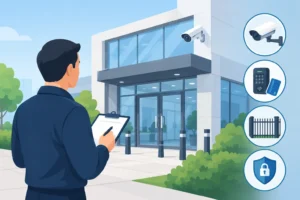
An alarm activation at 02:17 is not simply a security issue. It creates a decision: ask an employee to attend an unknown situation, leave the premises unchecked, or rely on a trained security response. The best commercial property protection options reduce that uncertainty by putting the right measures in place before an incident occurs. For businesses responsible for offices, warehouses, retail units, industrial sites and vacant buildings, protection should support safe operations as well as deter crime.
The right approach is rarely one service in isolation. A camera may provide evidence, but it cannot secure a damaged door. An alarm can alert a monitoring centre, but someone still needs to attend. Effective protection combines technology, trained personnel and clear site procedures around the risks that matter to your premises.
Choosing the best commercial property protection options
Start with the property rather than a standard security package. Consider when the building is occupied, who holds keys, the value and portability of stock, the condition of perimeter fencing, past incidents, and how quickly a responsible person can safely attend outside working hours. A busy office with controlled daytime access has different requirements from an isolated warehouse, a multi-tenant commercial site or an empty unit awaiting redevelopment.
It is also worth separating deterrence from response. Visible security measures can discourage opportunist offending, while response arrangements deal with alarm activations, attempted break-ins, fire exits left unsecured and other events that demand an on-site presence. The most dependable plans cover both.
Key holding and alarm response
Professional key holding and alarm response is one of the most practical ways to protect a commercial property around the clock. Instead of placing keys with a director, caretaker or member of staff, an authorised security provider holds them securely and attends when an alarm monitoring centre requests a response.
This protects employees from being expected to investigate a potentially dangerous incident alone. It also prevents the familiar disruption of late-night calls, cancelled plans and uncertain journeys to site. A trained officer can assess the external condition of the premises, liaise with police or emergency services where required, manage access for contractors and secure the building following an incident.
The value of this service depends on procedure. Keyholding arrangements should document who can authorise access, which areas are sensitive, what to do if keys cannot be used, and when escalation is needed. A provider should also maintain accurate key records and test that instructions remain current, particularly after changes in personnel, alarm systems or building layouts.
Mobile security patrols
Mobile patrols provide a visible, flexible presence without the cost of a permanently stationed officer. Officers visit at scheduled or varied times, check agreed points around the site and report concerns such as unlocked doors, signs of forced entry, damage, trespass or unsafe conditions.
For industrial estates, trade counters, retail premises and compounds with vehicles or stored equipment, patrols can make a meaningful difference after normal operating hours. The unpredictability of visit times can be useful where a property is vulnerable to repeat trespass or opportunist theft.
Patrols are not a substitute for continuous guarding where there is a high-value process, public-facing risk or a known threat requiring an officer on site at all times. Their strength is targeted coverage: regular checks, a professional presence and early identification of problems across one or several locations.
Manned guarding
Manned guarding is appropriate where security needs to be continuous, highly visible or closely integrated with daily operations. A security officer may control entry and exit, check visitors and contractors, monitor suspicious activity, conduct internal and external patrols, and provide immediate support during an incident.
This option is especially relevant for locations receiving regular deliveries, sites with expensive equipment, buildings undergoing works, healthcare environments and premises with out-of-hours activity. It can also strengthen customer and staff reassurance when a controlled presence is needed at reception or at a site entrance.
The trade-off is cost and management scope. Guarding should be designed around defined duties, shift patterns and clear reporting expectations rather than treated as a generic presence. A well-written assignment instruction helps ensure officers understand the site, emergency contacts, access restrictions and the level of authority they hold.
Open-up and lock-up services
Opening and closing a property is a routine task with genuine security consequences. A professional open-up service checks the site before staff arrive, identifies obvious signs of intrusion and allows authorised access at the right time. Lock-up services make sure doors, shutters, gates and designated areas are secure at the end of the day.
This is a sensible solution for small and medium-sized organisations that do not want managers carrying out lone working duties at unsocial hours. It can be particularly helpful for businesses with variable opening times, several units or staff who may otherwise be responsible for locking up alone.
The service works best when the closing checklist reflects the actual property. That may include checking fire doors, setting alarms, securing keys, inspecting loading areas and confirming that visitors and contractors have left the premises.
Vacant property inspections
Empty commercial property needs active management. Once a building is unoccupied, faults and security weaknesses can remain unseen for days or weeks. Broken windows, water leaks, unauthorised entry, fly-tipping, vandalism and fire risks can quickly become more serious and more expensive.
Vacant property inspections provide documented checks at agreed intervals. Officers can inspect access points, look for damage or signs of occupation, identify maintenance concerns and report findings to the responsible property manager. Where appropriate, they can arrange a response to secure the site or allow approved contractors access.
The frequency should reflect the building’s location, condition and risk profile. A vacant unit in a well-managed business park may require a different inspection schedule from a prominently located retail property with a history of trespass. Insurers may also specify conditions for unoccupied premises, so security arrangements should be checked against policy requirements rather than assumed.
Build protection around real operational risks
The strongest commercial security arrangements connect services rather than operating as separate tasks. Alarm response should work with accurate keyholding instructions. Mobile patrol officers need clear reporting routes for defects. Guarding teams should know the access protocols, evacuation procedures and contractor rules that apply to the site.
Technology has a role, but it should support people and process. CCTV, intruder alarms, access control and remote monitoring can improve visibility and provide timely alerts. They do not remove the need for a capable response when a door has been forced, a fire alarm activates or an authorised person needs secure access outside normal hours.
For multi-site organisations, consistency is equally important. Standard reporting formats, named contacts, agreed escalation paths and regular reviews make it easier to identify patterns across the estate. A recurring unlocked gate, repeated alarm activation or vulnerable delivery entrance may indicate a process problem rather than an isolated event.
What to look for in a security provider
Commercial property protection requires a provider that can be trusted with keys, access permissions and incident decisions. Ask how keys are stored and audited, how officers are selected and licenced, what happens if a response cannot be completed as planned, and how incidents are recorded and communicated.
Accreditation and operational history are useful indicators, but they should be matched by practical site knowledge. A provider should take time to understand the premises, identify realistic risks and recommend a proportionate service. Over-specifying security can waste budget; under-specifying it can leave staff, property and business continuity exposed.
For Greater Manchester businesses and organisations with wider UK requirements, Key Control Services combines keyholding, alarm response, patrols, guarding, opening and closing services, and vacant property inspections with SIA Approved Contractor Status and ISO 9001:2015 quality accreditation.
A useful next step is to walk the premises as they are at their most vulnerable: after closing, during a delivery, at shift change or when empty. The gaps become clearer when you view the site through the eyes of the person who would need to respond to a problem.