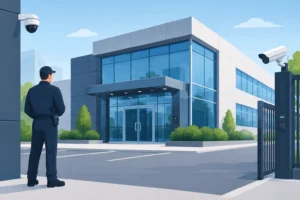
A gate left unsecured after a late delivery can affect far more than one unit. On a busy estate, it may create an opportunity for trespass, theft, fly-tipping or unauthorised vehicle access across several businesses. Effective security services for industrial estates are therefore about more than placing a guard at a gate. They provide a planned, accountable response that protects people, stock, vehicles, buildings and continuity of operations.
Industrial estates have particular pressures. Occupiers may work different shifts, share access roads, hold high-value equipment outside, or receive deliveries before and after standard office hours. A security arrangement has to reflect how the estate actually operates, not rely on a generic presence that looks reassuring but leaves gaps when they matter.
Why industrial estates need a joined-up security plan
An industrial estate can be difficult to secure because responsibility is often split. A managing agent may oversee common areas, while each occupier controls its own unit, alarm system and keys. This can leave uncertainty over who responds when an alarm sounds, a perimeter fence is damaged or an unfamiliar vehicle enters the site.
The most dependable approach brings common-area protection and individual premises support together. Estate-wide patrols can check gates, boundary lines, lighting, vacant units and suspicious activity, while separate services can protect each tenant’s building and access arrangements. The result is clearer responsibility and faster action when an issue is identified.
Crime is not the only concern. A security officer or mobile patrol can spot hazards such as an open fire door, water ingress, a failed shutter, unsafe loading activity or a vehicle blocking emergency access. Early reporting gives site managers an opportunity to act before a minor fault becomes an expensive disruption.
Risk varies across the estate
A distribution site operating through the night needs a different level of attention from a small engineering unit that closes at 5pm. Likewise, an estate with a history of attempted break-ins may require visible deterrence at key times, whereas a well-controlled business park may benefit most from regular out-of-hours checks and a reliable alarm response.
A proper assessment should consider the estate layout, public access points, vehicle movements, neighbouring land, lighting, existing CCTV, alarm coverage, shift patterns and the nature of goods held on site. It should also identify where a criminal could enter, conceal themselves or leave quickly. These practical details determine whether manned guarding, mobile patrols, key holding or a combination of services is appropriate.
Security services for industrial estates: the essential layers
No single measure prevents every incident. Physical security works best in layers, with each service supporting the others and creating a clear escalation route.
Controlled access and visible deterrence
Access control begins at the perimeter. Gates, barriers, pedestrian entrances and reception points should make it clear that access is managed. Security officers can verify visitors, contractors and deliveries, maintain records where required and challenge activity that does not match the site’s procedures.
Manned guarding is particularly valuable where an estate has frequent vehicle movements, valuable materials, sensitive operations or a public-facing entrance. A professional officer provides a visible presence, but their value also lies in consistent procedure: checking credentials, monitoring access, reporting defects and knowing what to do when an incident develops.
This option is not necessary for every location around the clock. For lower-risk estates, targeted guarding during high-risk periods may offer better value than continuous cover. The right decision depends on risk, operating hours and how quickly a problem could affect tenants or trading.
Mobile security patrols
Mobile patrols are a practical way to maintain an active security presence without the cost of a permanently stationed officer. Patrol officers can visit at varied times, inspect agreed points around the estate, test that doors and gates are secure, look for signs of attempted entry and report concerns promptly.
Unpredictable patrol timings are useful because they make routines harder to observe. However, patrols should never be treated as a substitute for an officer when a site needs immediate, continuous oversight. A large site with a constantly open gate, for example, may need dedicated personnel during operational hours, supported by patrols overnight.
Clear reporting is vital. Estate managers need to know that patrols took place, what was checked and whether any action is needed. Accurate records also help identify recurring issues, such as a regularly unsecured access point or persistent trespass near one boundary.
Key holding and alarm response
Alarm activations are one of the most common reasons commercial clients appoint a security provider. Sending a director, facilities manager or employee to an industrial estate in the early hours can place them in an uncertain situation, especially when the cause of the alarm is unknown.
Professional key holding and alarm response removes that burden. A trained, licensed responder attends with authorised keys and site instructions, assesses the situation, liaises with emergency services where necessary and secures the premises after the incident. The business receives a report without expecting its own staff to take personal risks or compromise their next working day.
For an industrial estate, arrangements should be agreed in advance. Responders need accurate details of access routes, unit locations, alarm procedures, key references, emergency contacts and any site-specific hazards. If a unit is leased, the tenant, landlord and managing agent should understand exactly who has authority to make decisions after an activation.
Open-up, lock-up and vacant unit protection
Opening and locking premises sounds straightforward, yet these routines are critical control points. An open-up service can confirm that a unit is safe before employees arrive. A lock-up service can check doors, windows, shutters and alarms at the end of a shift, reducing the chance that a simple oversight leaves a business exposed overnight.
Vacant units require particular attention. Empty industrial premises can attract trespass, vandalism, arson, illegal occupation and fly-tipping. Regular inspections demonstrate that the building is actively managed, while prompt reporting helps owners address broken fencing, damaged locks or signs of entry before problems escalate.
What to expect from a dependable provider
Industrial estates should not have to rely on vague assurances. A security provider should set out the scope of service, attendance expectations, communication routes and reporting standards from the outset. The estate team should know who to contact, what happens after an incident and how service performance will be reviewed.
Credentials matter because security work involves access to buildings, keys, alarm information and sensitive operational details. Look for a provider with SIA Approved Contractor Status, active SIA licences for relevant personnel and a documented quality-management approach. These indicators do not replace careful local planning, but they demonstrate that professional standards and accountability are taken seriously.
Experience also matters when a situation is unclear. An officer responding to a damaged gate, an alarm activation or suspicious activity must be calm, observant and able to follow escalation procedures without creating further risk. KCS combines experienced personnel with SIA Approved Contractor Status and ISO 9001:2015 quality accreditation, helping commercial clients place critical access and response responsibilities with confidence.
Create clear responsibilities before an incident
The strongest security plans are agreed before there is a problem. Estate managers, occupiers and the security provider should establish an up-to-date contact structure, including who can authorise emergency repairs, who receives incident reports and when the police, fire service or utility provider should be contacted.
Procedures should account for real-world events: late deliveries, contractors working beyond normal hours, lost keys, power failures, severe weather and vacant units changing hands. A plan that only works on a normal weekday is not enough for an industrial environment.
It is equally useful to review incidents and near misses. If patrol officers repeatedly find a side gate unsecured, the answer may be staff training, a repair, a revised delivery process or an adjustment to patrol timing. Security should support better site management, not merely record that a problem occurred.
For businesses and managing agents, peace of mind comes from knowing that someone competent is available when the site is quiet, an alarm activates or access needs controlling. A tailored security plan gives an industrial estate the discipline to operate confidently, whatever the hour.