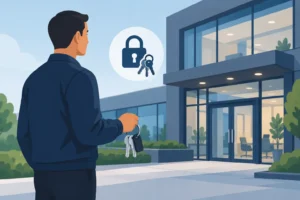
An alarm at 2.15am creates an immediate decision: who has the keys, who can attend safely, and who is authorised to decide what happens next? That is the practical question behind when do businesses need key holding. For many commercial organisations, the answer is sooner than they expect – particularly once an out-of-hours call means asking an employee, director or facilities manager to attend a potentially unknown situation alone.
Professional key holding gives a trained, licensed security provider controlled access to your premises and a clear response plan when alarms activate, incidents occur or emergency access is required. It removes the pressure from internal keyholders while protecting business continuity, staff welfare and property.
When do businesses need key holding?
A business needs key holding when access to its premises must be available outside normal working hours, but relying on employees or managers is no longer a sensible or safe arrangement. This may be because the site contains valuable stock, sensitive information, specialist equipment or critical infrastructure. Equally, it may be because there is simply no suitable member of staff available to respond at short notice.
The need is particularly clear after an alarm activation. An alarm may be false, but it could also indicate attempted entry, damage, fire, flooding or an internal fault. Sending an untrained keyholder into that environment can expose them to avoidable risk. A professional responder can attend, assess the immediate situation, liaise with emergency services where needed and secure the site in line with agreed instructions.
Key holding is not only for large organisations. A single retail unit, office, surgery, warehouse or workshop can face significant disruption if a break-in, alarm fault or access issue is not handled quickly. Smaller businesses often feel the impact more sharply because one director or manager may otherwise carry all out-of-hours responsibility.
Signs your current keyholder arrangement is creating risk
Many businesses begin with an informal arrangement. A director keeps a set of keys at home, a manager is named as the alarm contact, and staff assume somebody will deal with a problem if one arises. This can work for a time, but it often becomes fragile as the business grows, staff change or sites become more complex.
A review is worthwhile if your nominated keyholders live some distance from the premises, regularly travel, work alone, or cannot reliably answer calls overnight. It is also sensible where several people hold keys without a clear record of who has access, or where alarm response depends on a single individual who may be ill, on holiday or unavailable.
Other warning signs include repeated alarm activations, previous break-ins, a vacant building, high-value stock, late-night trading, or a site in an isolated location. None of these automatically means an incident will occur. They do, however, raise the consequence of a delayed or poorly managed response.
Alarm response should not depend on goodwill
Asking staff to attend an alarm call-out can seem cost-effective until the real cost is considered. There is the personal safety risk, the time taken away from work and family, the possibility of arriving before police or emergency services, and the uncertainty of what they may find. Employers also need to consider their duty of care when employees are expected to visit a site outside normal hours.
Professional key holding and alarm response creates a defined process instead of an improvised one. The security team holds authorised keys or access devices securely and receives instructions specific to the site. On activation, trained officers attend, inspect the premises where appropriate, identify visible signs of damage or intrusion, and take agreed action.
That may involve resetting an alarm, allowing an engineer access, meeting police or fire services, arranging emergency boarding-up, or remaining on site until the premises are safe. The correct response depends on the incident and the client’s instructions. A reputable provider should not treat every activation as identical.
Premises that benefit most from key holding services
The strongest case for key holding is often found in premises where a delay could lead to greater loss, disruption or liability. Industrial units and warehouses may hold machinery, stock and tools that are attractive to intruders. Offices can contain IT equipment, client records and confidential documents. Retail sites may face exposure from accessible display areas, cash-handling equipment or stock rooms.
Healthcare settings, schools and public-facing premises also require careful access control. In these environments, the concern is not only theft or damage. Unauthorised access can create safeguarding, privacy and operational issues that require a disciplined response.
Vacant commercial properties deserve particular attention. An empty site can be targeted for trespass, theft, vandalism, fly-tipping or unauthorised occupation. It may also suffer unnoticed water leaks, storm damage or fire-related issues. Key holding works well alongside mobile patrols, vacant property inspections and open-up or lock-up services, providing a practical layer of protection while the property is unoccupied.
Multi-site operations need consistency, not separate arrangements
For a business with multiple locations, relying on local managers to hold keys can produce uneven standards. One branch may have a clear register and reliable cover, while another relies on a member of staff who has moved roles or left the organisation. During an incident, this inconsistency can cost valuable time.
An outsourced key holding arrangement centralises the process. Each location can have its own response instructions, access requirements and escalation contacts, while the business retains oversight of who is authorised and what action should be taken. This is useful for estate managers, facilities teams and organisations opening or closing sites at different times.
There is a trade-off to consider. A provider needs accurate site information, up-to-date contacts and clear authority levels to work effectively. Businesses should therefore treat key holding as part of their security management process, not simply hand over a key and assume every scenario is covered.
What a dependable key holding provider should provide
Trust is central to this service. You are placing access to your business premises in another organisation’s hands, so credentials, processes and people matter. Look for a provider that can demonstrate recognised security standards, active SIA licensing and experience in alarm response and physical site protection.
You should also expect secure key management, documented response procedures and communication that is clear after an incident. The provider should understand who can authorise contractors, when emergency repairs can be arranged and when senior contacts need to be called. A response that is quick but poorly controlled can still create risk.
For businesses in Greater Manchester and beyond, local operational capability can make a meaningful difference when an urgent attendance is required. Key Control Services provides key holding and alarm response as part of a wider, 24/7 property protection service, supported by SIA Approved Contractor Status and ISO 9001:2015 quality accreditation.
Key holding also supports daily operations
The value of professional key holding is not limited to alarms. It can support planned access when a responsible employee cannot be present. For example, a security officer may open a site for an engineer, provide controlled access for a contractor, or lock up after an event or late shift.
This can be useful where business owners do not want to distribute additional keys, leave premises unsecured while waiting for tradespeople, or ask staff to work beyond their scheduled hours. The arrangement needs clear instructions and sensible limits, but it can reduce administrative pressure while retaining control over access.
Making the decision before an incident happens
The best time to arrange key holding is before a security incident reveals a weakness. Review who currently holds keys, who is named as an alarm contact, how quickly they could attend, and whether they are equipped to deal with an uncertain situation. Then consider the practical impact if nobody answered the call.
If the answer involves staff travelling alone at night, delayed access for emergency services, or a site remaining unsecured until morning, professional key holding is likely to be a proportionate safeguard. A clear response plan gives your people the confidence that they will not be expected to take unnecessary risks, while your premises remain protected when they are most vulnerable.